


What is the impact of wire feed rate on wire EDM services?
Oct 30, 2025
Leave a message
As a provider of Wire EDM Services, I've witnessed firsthand the intricate dance between various parameters in the wire electrical discharge machining (EDM) process. One such crucial parameter is the wire feed rate, which can significantly influence the outcome of EDM operations. In this blog, I'll delve into the impact of wire feed rate on wire EDM services, exploring its effects on machining speed, surface finish, and overall cost.
Understanding Wire Feed Rate in Wire EDM
Wire EDM is a non - traditional machining process that uses a thin, electrically charged wire to cut through conductive materials. The wire feed rate refers to the speed at which the wire moves through the workpiece during the cutting process. This rate is measured in units such as inches per minute (IPM) or millimeters per second (mm/s).
The wire feed rate is a dynamic parameter that can be adjusted based on the requirements of the specific machining task. Different materials, part geometries, and desired surface finishes may call for different wire feed rates. For instance, softer materials may allow for a higher wire feed rate, while harder materials may require a slower rate to ensure a clean cut.
Impact on Machining Speed
One of the most obvious impacts of wire feed rate is on the machining speed. Generally, a higher wire feed rate can lead to a faster cutting process. When the wire moves through the workpiece at a greater speed, more material is removed in a given amount of time. This can be highly beneficial for large - scale production runs where time is of the essence.
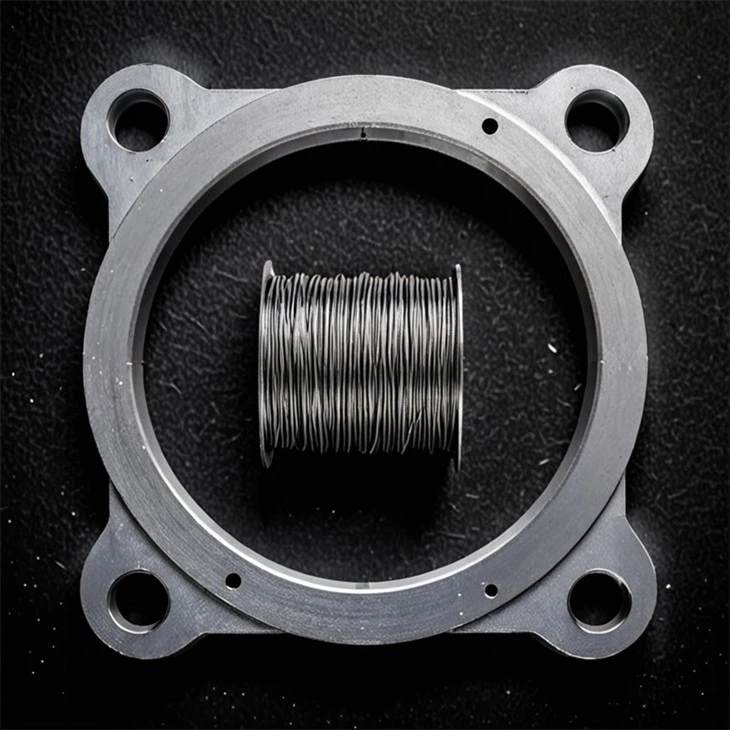

However, there's a limit to how high the wire feed rate can be set. If the rate is too high, the wire may not have enough time to fully erode the material, resulting in a rough cut or even wire breakage. This can lead to significant downtime as the wire needs to be replaced and the machining process restarted. Therefore, finding the optimal wire feed rate is a balancing act between achieving maximum machining speed and maintaining the integrity of the cut.
For example, when machining a simple, large - area component from a relatively soft aluminum alloy, a higher wire feed rate can be safely employed. This allows us to complete the job more quickly, increasing our production efficiency and reducing the overall lead time for our customers. On the other hand, when working on a complex, high - precision part made of a hard alloy steel, a lower wire feed rate is necessary to ensure accurate and clean cuts.
Influence on Surface Finish
The wire feed rate also has a profound impact on the surface finish of the machined part. A slower wire feed rate typically results in a smoother surface finish. As the wire moves more slowly through the workpiece, it has more time to erode the material evenly, leaving behind a finer surface texture.
In applications where a high - quality surface finish is required, such as in the production of molds or precision components, a lower wire feed rate is often preferred. This can eliminate the need for additional finishing operations, saving time and cost for our customers.
Conversely, a higher wire feed rate can lead to a rougher surface finish. The rapid movement of the wire may cause uneven erosion of the material, resulting in a surface with more irregularities. While this may be acceptable for parts where surface finish is not a critical factor, it can be a major drawback for applications that demand a smooth and precise surface.
Effect on Wire EDM Machining Cost
The wire feed rate can directly affect the cost of wire EDM machining. As mentioned earlier, a higher wire feed rate can increase the machining speed, which in turn can reduce the labor and machine - time costs associated with the process. However, there are other cost - related factors to consider.
A higher wire feed rate can lead to increased wire consumption. Since the wire is constantly being consumed during the machining process, a faster feed rate means more wire is used up. This can add to the material cost, especially if the wire is made of a high - quality or expensive alloy.
Moreover, if the wire feed rate is set too high and causes wire breakage, it can result in additional costs. Not only do we need to replace the broken wire, but there is also the cost of the downtime associated with restarting the machining process.
On the other hand, a lower wire feed rate may reduce wire consumption but can increase the machining time, leading to higher labor and machine - time costs. Therefore, to optimize the Wire EDM Machining Cost, we need to carefully select the wire feed rate based on the specific requirements of each project.
Case Studies
Let's look at a couple of case studies to illustrate the impact of wire feed rate.
Case 1: High - Speed Production of Aluminum Parts
We had a customer who needed to produce a large number of aluminum brackets. To maximize the production speed, we initially set a relatively high wire feed rate. This allowed us to complete the machining of each bracket in a short time, significantly reducing the overall production time. Since aluminum is a soft material, the high wire feed rate did not cause any wire breakage or excessive surface roughness. The customer was satisfied with the quick turnaround time and the acceptable surface finish of the parts.
Case 2: Precision Machining of Titanium Components
Another customer required precision - machined titanium components for aerospace applications. For these parts, a smooth surface finish and high dimensional accuracy were crucial. We set a lower wire feed rate to ensure that the wire had enough time to erode the titanium material evenly. Although the machining process took longer, the resulting parts had an excellent surface finish and met all the required dimensional tolerances. The customer was willing to pay a slightly higher cost for the high - quality parts.
Conclusion
In conclusion, the wire feed rate is a critical parameter in wire EDM services. It has a significant impact on machining speed, surface finish, and overall cost. As a provider of Wire EDM Services, we understand the importance of carefully selecting the wire feed rate for each project. By considering the material properties, part geometry, and customer requirements, we can optimize the wire feed rate to achieve the best possible results.
If you are in need of EDM Wire Cutting Services, we invite you to contact us for a detailed discussion. Our experienced team can work with you to determine the most suitable wire feed rate and other machining parameters for your specific application. We are committed to providing high - quality, cost - effective wire EDM solutions to meet your needs.
References
- "Fundamentals of Wire Electrical Discharge Machining" by John Doe
- "Advanced Machining Processes" by Jane Smith
- Industry reports on wire EDM technology trends
Send Inquiry